
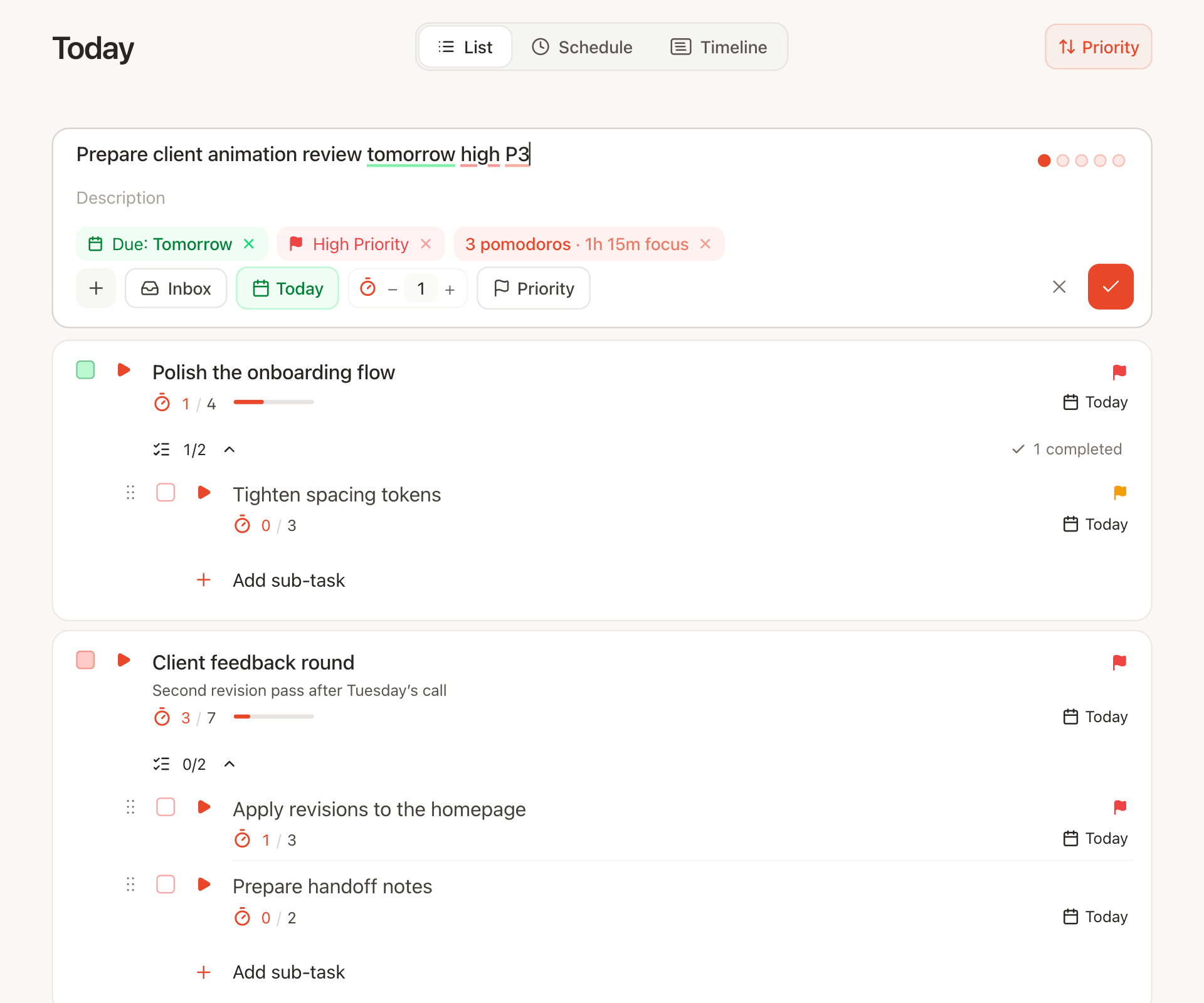
As a freelance motion designer, I used to estimate work in vague units: quick, half a day, probably tomorrow. Those estimates sounded harmless until several client projects overlapped and every small task began competing for the same afternoon.
Hours can feel abstract before the work starts. A focus block is easier to picture. Can I review the brief in one focused session? Will the animatic need three? Does rendering need my attention, or only elapsed machine time?
A Pomodoro is a planning unit, not a promise
A Pomodoro estimate describes focused effort. It is not a quote, a deadline, or a guarantee that creative work will behave predictably. The point is to make the work visible enough to plan.
In Pomiq, one planning block includes the focus session and the short break that follows it. That matters when you place work on a real day. Four 25-minute focus sessions are not a two-hour calendar block if you also need the breaks that keep those sessions useful.
Start with deliverables, not the whole project
A project called “Launch film” is too large to estimate honestly. Break it into steps that produce a visible result: review the brief, prepare the storyboard, build the animatic, animate scene one, collect feedback, and export the final versions.
Then ask one question for each step: how many uninterrupted focus sessions would this take if the inputs were ready?
A simple first pass might look like this:
Brief review: 1 Pomo. Storyboard notes: 2 Pomos. Animatic: 4 Pomos. First animation pass: 6 Pomos. Revisions: 3 Pomos. Delivery: 1 Pomo.
The total is useful, but the task breakdown is what makes it believable. It also shows where a missing asset or client decision can stop the work.
Separate focus, waiting, and uncertainty
Creative projects contain three different kinds of time. Focus time needs your attention. Waiting time belongs to renders, uploads, and feedback. Uncertainty belongs to work that has not been defined yet.
Do not turn all three into extra Pomodoros. Estimate the focused effort you can control. Put waiting work on hold when it leaves your hands. Add a follow-up date so it returns before silence turns into urgency.
For uncertainty, add a small buffer to the risky task instead of inflating every step. A new visual direction may deserve two exploratory Pomodoros. A familiar export probably does not.
Compare the estimate with real focused time
The estimate becomes more useful after the project. If an animatic planned for four Pomodoros consistently takes seven, that is not a personal failure. It is better information for the next proposal.
Keep planned effort and recorded time separate. Completed focus sessions show what actually required attention. Recorded breaks stay breaks. Render time does not quietly become billable focus unless that matches the agreement with the client.
Use the smallest version on your next project
Choose one active client project. Break only the next deliverable into tasks. Give each task a focus estimate, then compare it with the sessions you actually complete. One honest week will teach you more than a perfect template built from guesses.
Try estimating one client project in Pomiq. Start with the next deliverable, not the entire backlog.