
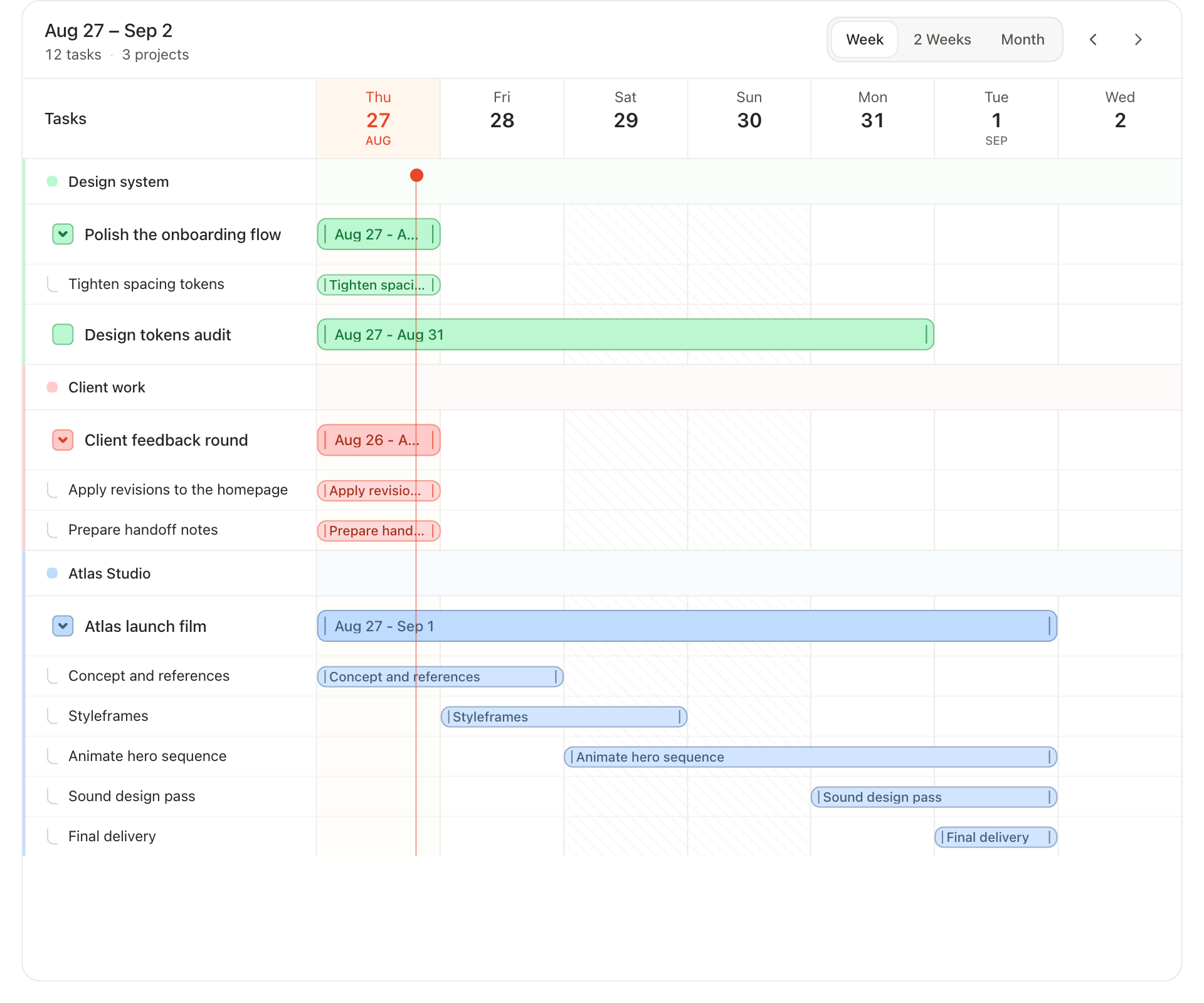
As a freelance motion designer, I rarely had one project moving in a straight line. One client was waiting for an animatic. Another had sent revisions. A third had a deadline next week but needed a small decision today.
The stressful part was not always the amount of work. It was keeping every project mentally active at the same time.
Start with the week, then choose today
A daily list is easier to trust when it comes from a visible week. Place the real start and due dates first. Then look for collisions before the morning begins.
If three tasks need six focus sessions each and all end on Friday, no priority label will create the missing hours. Move the flexible work, reduce scope, or speak to the client while there is still room to change the plan.
Keep only one task in the foreground
Several projects can be active without every task being equally immediate. Pick one task for the next focus session. Keep the rest visible in the plan, not active in your head.
I use three questions:
What has the nearest real consequence? What is ready to move now? What can I finish or hand off in one or two focus sessions?
The answer becomes the current task. It does not make the other projects less important. It only gives the next block a clear owner.
Do not let paused work occupy active space
Client work often stops for a reason outside your control. Feedback has not arrived. Assets are missing. A stakeholder is away.
Keep the dates that explain the project plan, but move the task to On Hold. Add a follow-up date based on when you actually want to check again. Until then, it should not compete with work that can move today.
When that date arrives, review the held task. Resume it only if there is a next action. A follow-up is a prompt to decide, not an automatic deadline.
Build a day that includes transitions
A calm schedule is not a wall of back-to-back tasks. Reserve complete focus blocks, including breaks. Group work from the same project when possible so your attention does not have to rebuild the context every thirty minutes.
A realistic day might contain two focus blocks for the urgent animation pass, one block for client communication, lunch, two blocks for the second project, and one smaller review block near the end. The empty space is not wasted. It absorbs messages, exports, and the ordinary friction of creative work.
Close the day by moving work, not carrying guilt
Unfinished work needs a decision. Move it to the right day, put it on hold, or reduce the next action until it fits. Leaving everything overdue turns tomorrow into a punishment before it starts.
The goal is not to produce a perfect schedule. It is to make one believable promise to today while the rest of the week stays understandable.
Plan your next freelance day in Pomiq. Start with the real deadlines, then choose one task for the first focus session.